12
Nov
How to Spot a Fake Leather Jacket: 7 Tests You Can Do at Home
You see a jacket on a rack, or maybe you spot it online. The tag claims leather and the price certainly grabs your attention. For the first ten seconds it feels great. Then a few months later the surface is flaking around the cuffs, and suddenly you're asking yourself what you actually paid for.
It happens a lot because faux leather has gotten very good at looking the part. But give it a closer look, be a bit patient and you'll see right through it. You don't need to go to the laboratory or use a special kit. Your finger tips, nose, and a tumbler of water will do the trick for most of those. Carry out these seven examinations yourselves before believing you'd got the real thing.
1. Smell Test: How Real Leather Smells Compared to Fake Leather
It sounds a bit silly. Still, it's the fastest test you'll find. Real leather gives off an earthy, warm smell. Faux leather, on the other hand, smells like plastic. Sometimes it's sharp and chemical. Other times it reminds you of a new shower curtain.
You should smell the inside fabric of the clothing for example around the neckline or under your arms since the outer coating might conceal a lot. Real leather, when new, typically has a rather intense smell of tanning chemicals but this will be greatly reduced through airing. If however you smell a sour chemical odor that sticks around then you are probably dealing with something else.
Quick check:
- Earthy, rich smell is a good sign
- Plastic or glue smell is a red flag
- A strong smell that is still there after a day of airing needs a closer look
2. Touch Test: How Real Leather Feels Different From Faux Leather
Slide your hand along the sleeve and keep it there for about ten seconds. If it's true leather, you'll feel it's initially cool and will warm up very fast to the touch of your hand. It's pliable, with just a slight unevenness and some elasticity, similar to skin.
Faux leather feels smooth and flat. It tends to stay cool for longer, and some types get slightly sticky or rubbery when your hand sits on them.
What to notice:
- It warms up fast under your hand
- Texture varies a little from panel to panel
- A slick, plastic feel is a warning sign
3. Grain Test: How to Check Leather Texture and Pores
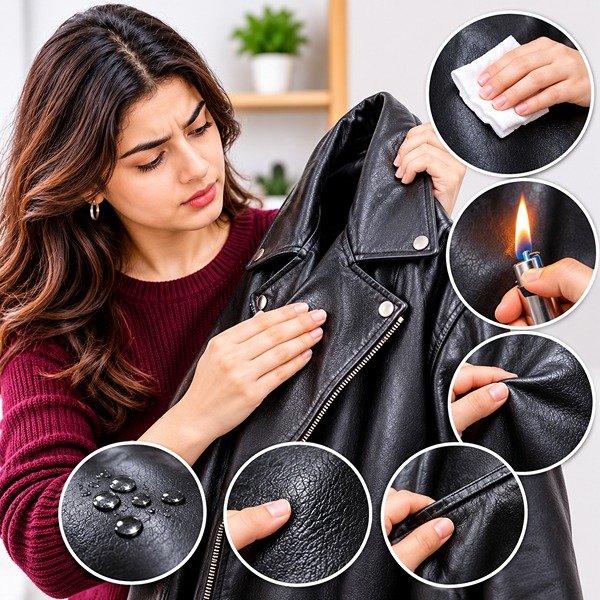
To examine a piece of leather, either place it under a strong light or use your phone light at an angle, focusing on the details through the camera. A real leather hideskin should appear with tiny pores and a very slight irregular skin surface (the hair follicles), some minor wrinkles in the grain, and also some natural skin spots. The two spots will never quite match, though. On the other hand, fake leather usually has a pattern that is stamped onto the surface, so there will be a same repeated texture, almost like a wallpaper.
Remember one thing: real leather can also be embossed or sanding re-texturing it so it looks very even too. Just because the surface is flawless does not mean it is real combine all the tests.
What to look for:
- Irregular pores that change across the panel
- No repeating pattern
- Small natural marks are normal and usually a good sign
4. Wrinkle Test: How Real Leather Reacts When You Press It
Press your finger into the leather and move it forward slightly. Real leather will form fine, soft wrinkles around your fingertip that look exactly like when the human skin wrinkles. Those wrinkles slowly disappear when you take finger off. Faux leather behaves differently, its either smooth and can be stretched like a spring, or it can form stiff and sharp creases that disappear so fast that it is like they were there only for a second.
Try also getting a small patch of the material between your fingers by using only two fingers at a time. The real leather will gather into little natural furrows when pinched. An artificial layer on top will have the look of a transparent film. A fresh biker jacket may have a rigid feel either way, don't look at stiffness as the clue but rather, look closely at the wrinkling pattern.
Quick check:
- Fine wrinkles that fade slowly
- Pinched leather folds softly
- Sharp, even creases or an instant bounce back are suspicious
5. Water Drop Test: Does Water Soak Into Real Leather?
Choose an obscure place, maybe the inside of the hem. Put one little drop of water on it and leave it be for about a minute or two. If it's real leather, it will slowly absorb the water, a little patch will turn a little darker color and then it will return to its original dryness. Whereas, a water drop on counterfeit leather is likely to remain on the surface like a bead never getting soaked in
Keep it to one drop and dab it dry with a soft cloth afterwards. Heavily finished real leather can resist water for a while too, so if the drop just sits there, don't decide yet. Check what the other tests are saying.
Keep in mind:
- One drop only, in a spot nobody sees
- Slow absorption is a good sign
- Water that beads and stays put points to a plastic coating
6. Edge Test: How to Check the Edges and Back of a Leather Jacket
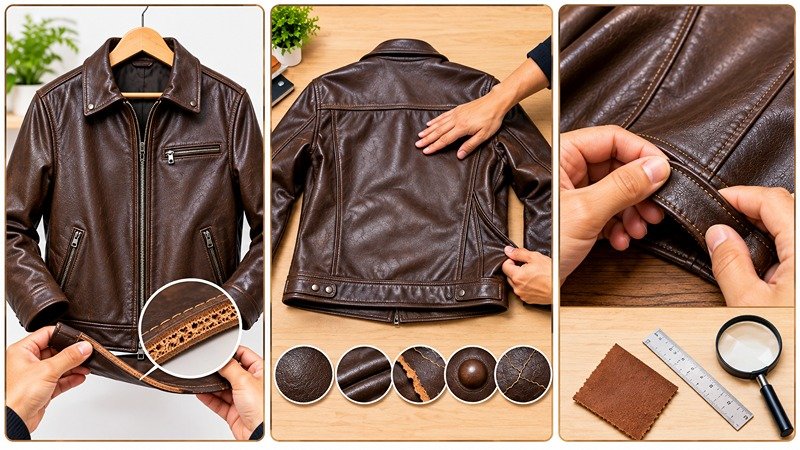
Look at any cut edge you can find, like inside the cuff, along the hem or under the lining. There's a distinct difference between a genuine leather and a faux one, as the cut edge looks different. Real leather is rather fibrous and rough, while underneath it resembles suede. Faux leather, on the other hand, is generally backed with a fabric layer you might notice a kind of woven or knitted mesh, and above it a plastic layer which is smooth.
Peeling is the other giveaway. If you spot a thin film lifting at the collar, cuffs or elbows, that's a coating coming away from its backing. Real leather can crack with age or neglect, but it doesn't come off in sheets.
Details worth checking:
- A fibrous, uneven edge
- A suede-like back
- Visible fabric mesh or peeling film means faux
7. How to Read a Leather Jacket Label, Stitching and Price
Labels need a bit of translation. “Genuine leather” sounds like the top grade, but it's actually a lower one. It is real leather, usually made from the lower layers of the hide. Therefore, you should go with the ones labeled "full grain" or "top grain" since they represent higher quality leather. Terms like PU, polyurethane, man-made, or vegan leather basically indicate that the product does not contain any animal leather. Lastly, "bonded leather" is nothing more than scraps of leather glued together, which is very easily worn out.
Then look at the stitching. Even, tight stitches, clean seams and heavy zips and snaps are what you want. Cheap hardware feels light and rattly. And be honest about the price. A full grain jacket at a bargain price should make you stop and ask where the savings came from.
Quick check:
- Look for full grain or top grain on the tag
- Check the care label for PU, polyester or man-made material
- Zips should feel heavy and run smooth
8. Is the Burn Test Safe for Checking Real Leather?
You'll see this one in a lot of guides. Hold a flame to a small spot and see how it burns. We wouldn't. It ruins the jacket, burning plastic gives off nasty fumes, and coated real leather can react in odd ways too, so the result isn't even reliable. The seven tests above are safer and tell you plenty.
9. What to Do When Fake Leather Test Results Don't Match
The test is not the same for all types of leather, more especially the coated or embossed real type. There's no one size fits all test, so the best approach is like adding up scores. A jacket flunks one test, there's no harm in the others. A couple to three failures, for example, plastic smell, a recurring grain and fabric back, and the matter is settled.
If buying online, there's no way to test the product with the senses. So one has to ask the seller to make available zoomed in photos of the grain, inside edges, etc., and at the same time, have a close look at the leather type stated.A seller who's vague about it usually has a reason.
Why Buy Genuine Leather Jackets From Zafy Leather?
A good leather jacket should feel right from the first wear and get better the longer you own it. That's hard to get from a coated plastic material, which is why it pays to know what you're buying.
Zafy Leather offers premium genuine leather jackets, blazers, dresses, skirts and trench coats for men and women, made to be worn across seasons and occasions. Delivery is free worldwide on all orders, so it doesn't matter whether you're in New York or Berlin.
Once your jacket arrives, our leather care guide covers cleaning and storage. Check the size guide for shoulder and sleeve measurements before you order, and if you have a very specific idea in mind, you can customize your jacket online.
Share this post

RELATED
Posts
Oversized Bomber vs Fitted Biker Jacket: Which Leather Style Suits You?

How to Store Leather Clothes Safely Between Seasons